

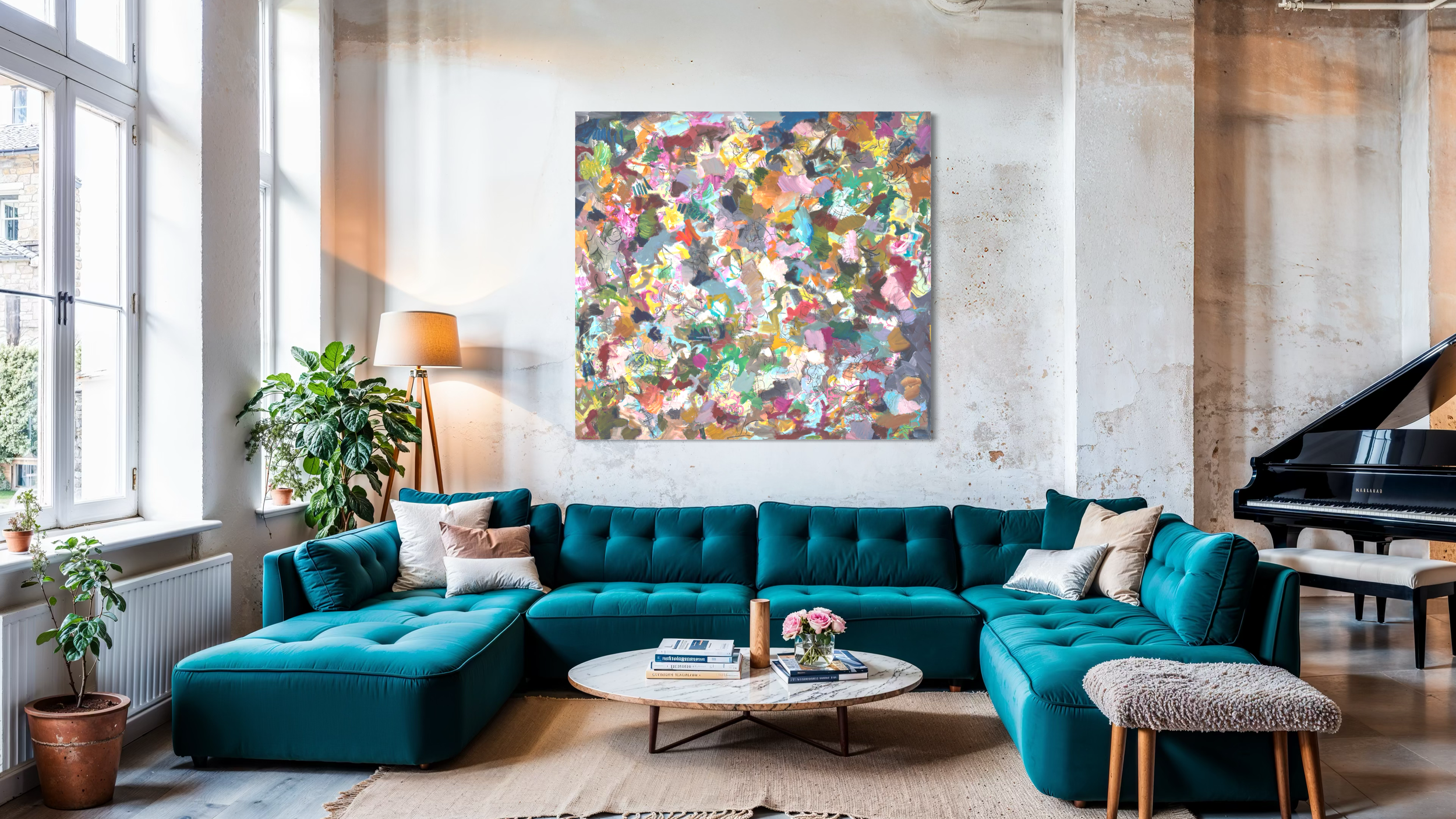
Nedret Andre
Eelgrass meadows move constantly. They gather, thin, tangle, reappear. I respond to this behavior through repetition: color and accumulations of marks, shifts in density, passages of calm and disruption. My work does not illustrate these systems but embodies their patterns—the way they resist visibility while remaining essential.
NEDRET ANDRE | Arlington, Massachusetts, USA
Juror’s Choice Award
Forest and Ocean
54 x 77", oil on canvas
$11000
Unraveled
48 x 60", oil on canvas
$8600
160K
72 x 78", oil on canvas
$16000
ARTIST STATEMENT // My work is rooted in long-term observation of submerged coastal systems, particularly eelgrass (Zostera marina). For over a decade, I've developed an abstract painting practice that translates the movement, density, and rhythms of these systems into layered, gestural form.
Eelgrass meadows move constantly. They gather, thin, tangle, reappear. I respond to this behavior through repetition: color and accumulations of marks, shifts in density, passages of calm and disruption. My work does not illustrate these systems but embodies their patterns—the way they resist visibility while remaining essential. My practice begins with keen observation—hours spent watching tides rise and recede, noting how light fractures across surface and depth, how sediment settles and lifts. These experiences feed an intuitive studio process where abstraction becomes a form of attention. In the studio, marks accumulate and dissolve. Color shifts echo changing light and depth. The paintings hold tension between structure and drift, stability and loss. This visual language has developed through years of field engagement, environmental research, and collaboration with marine restoration efforts along the Northeast coast. Each location imprints its own tempo, palette, and sense of vulnerability.
Scientific understanding enters my work not as data to illustrate, but as a way of deepening my relationship to living systems. Nantucket's coastal environments—particularly its eelgrass beds, increasingly pressured by warming waters and coastal development—offer urgent terrain for this inquiry. Situated at the convergence of cold and warm currents, the island's eelgrass communities exist near the edge of their viable range. Eelgrass along Nantucket and Madaket Harbor would provide ample observation opportunities. It grows at a depth of about 2 feet in both harbors. The EAIR residency provides essential time and proximity to deepen my engagement with these fragile systems and to translate their quiet persistence into painterly form.
BIO // Nedret Andre is a Boston-based painter whose abstract work engages with eelgrass meadows and submerged coastal ecosystems. Her practice is informed by direct collaboration with marine scientists and participation in seagrass restoration efforts throughout Massachusetts. Andre translates field observations into gestural, layered paintings that embody the rhythms and structures of these threatened habitats. She holds a BFA in Painting from Massachusetts College of Art and an MFA from Maine College of Art. Her solo exhibitions include Beacon Gallery, Sara Nightingale Gallery, Chashama Spaces (New York), and Stetson Gallery, among others. Her work has been featured in group exhibitions at the Monmouth Museum, Danforth Museum, Kingston Gallery, and Piano Craft Gallery. Andre's paintings are held in international collections across Egypt, France, Germany, Korea, Norway, Turkey, Switzerland, and the United Kingdom, as well as institutional collections including Mount Auburn Hospital, Cape Cod Hospital, the deCordova Museum Corporate Art Loan Program, and Lasell Village Public Arts Collection. Her work has been reviewed in Art New England, ArtScope Magazine, and IFDA New England.

CURATORIAL STATEMENT
Nedret Andre’s work arrives at a moment when Boston’s creative and corporate communities are being asked to think more expansively about responsibility, place and impact. Through her practice rooted in intentional observation and material sensitivity, Andre draws our attention to fragile coastal ecosystems—not as distant environmental issues, but as living systems that shape our economy, culture and our collective future. The work operates at the intersection of aesthetics and advocacy. Nedtret’s work is visually compelling, intellectually grounded and also deeply attuned to how rising waters, shifting shorelines and human intervention redefine the spaces we inhabit. This resonates with us at Juniper Rag and with our juror, who is invested in healthy coastal environments. From a curatorial perspective informed by Jess Klay’s careful choices and Juniper Rag’s forward-leaning ethos, we see Andre’s work as especially powerful in public-facing environments. Offices, lobbies, and shared corporate spaces are no longer neutral backdrops. They are cultural statements in the most demonstrative way. When companies integrate art that reflects ecological awareness, they signal leadership, accountability, and long-term thinking. The presence of this kind of work fosters daily engagement, encourages reflection, and contributes to the employee wellness that Jess speaks about—reminding people that their work exists within broader environmental and civic ecosystems. For organizations seeking cultural credibility, Andre’s work offers an immersive connection. It establishes a visual language of care and consciousness, positioning a company as an active participant in the future of its region. In a coastal city like Boston, that message resonates deeply. Art in public and professional spaces becomes a form of leadership—shaping how teams feel, how visitors perceive a brand, and how institutions demonstrate their commitment to community, environment, and the power of ideas. —Juniper Rag